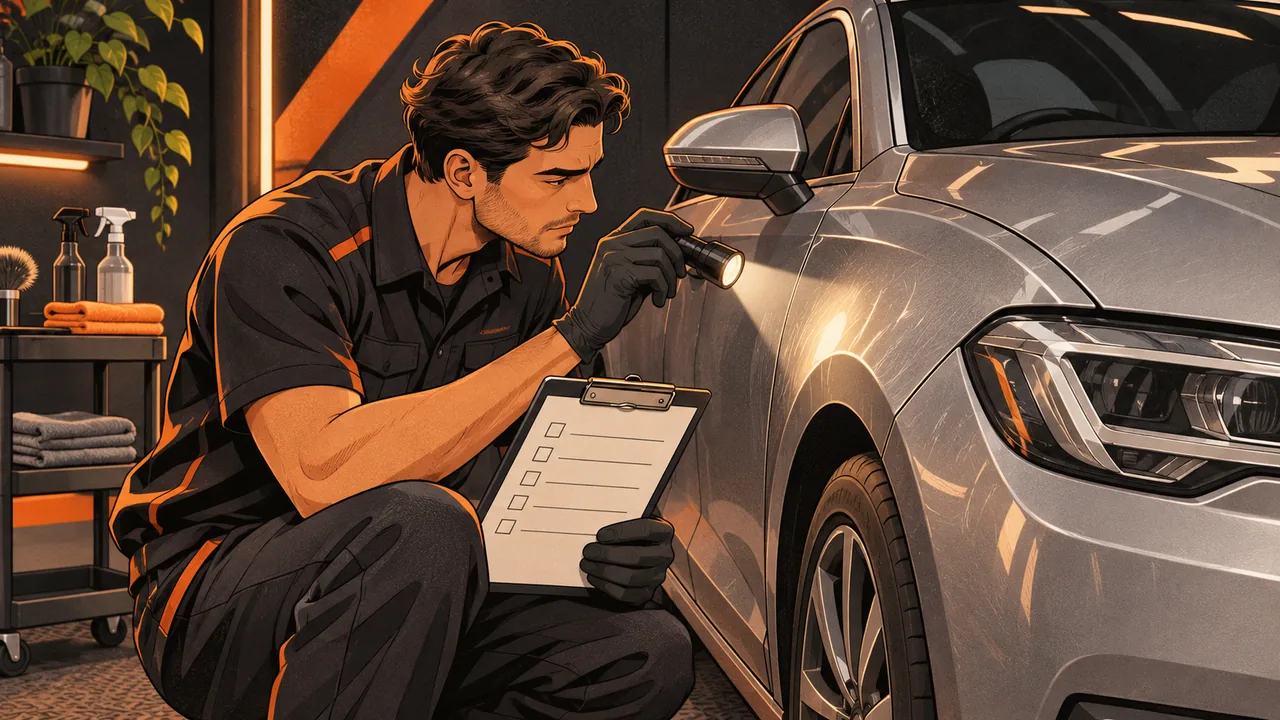
Before touching a vehicle, confirm the customer's goal, walk around it in a consistent order and record the conditions that could change the work. An intake inspection creates a shared starting point. It does not guarantee that every hidden defect or contamination source has been found.
Keep the first inspection observational. Do not remove trim, disconnect seats, test unfamiliar controls or experiment with a cleaner merely to find out what happens. Those actions can introduce new risks before a scope is agreed.
Begin with the conversation
Ask what prompted the appointment and which result matters most. “The interior smells damp after rain” requires a different response from “I want the cabin cleaned before a road trip.” Record the customer's description without converting it into a diagnosis.
- What changed, and when was it first noticed?
- Has the vehicle had paintwork, film, coatings, upholstery repair or aftermarket accessories?
- What cleaning products or treatments have already been used?
- Are there damaged areas or controls the customer wants left alone?
- Who can approve a change to the work, and what is the pickup deadline?
Walk the exterior in one direction
Start at a familiar point and continue around the vehicle. Note obvious chips, scratches, peeling finish, damaged trim, loose parts and areas obscured by soil. Take an overall photograph before detail images so another person can identify the location.
Identify special surfaces such as matte paint, wraps and paint protection film. If a material cannot be confirmed, mark it for review. A shiny panel is not proof that every adjacent surface will tolerate the same process.
Use appropriate lighting to check the finish, but recognize that a dirty vehicle can hide defects. Describe the inspection as preliminary when a wash and closer evaluation are needed. 3M's finishing guidance emphasizes adequate light when evaluating paint; a quick view under one ceiling fixture is limited evidence.
Inspect the cabin by zones
Move from the driver's area to the passenger area, rear seating and cargo space. Identify materials, stains, wear, loose trim, valuables and visible moisture. Check whether extra mats, a third row, storage bins or a cargo cover are included in the requested service.
Distinguish an observation from a conclusion. “Dark mark on the seat bolster” describes what you can see. “Permanent dye damage” requires more evidence. “Odor reported after rain” is useful history; “mold throughout the HVAC” is an unsupported diagnosis without an appropriate assessment.
Check the specific vehicle's care instructions before cleaning sensitive components. A Ford interior-care example gives different restrictions for screens, seat belts and suede-like material. It illustrates why one interior recipe should not be transferred to every vehicle.
Flag concerns that change the job
Stop and seek the appropriate review when you find an active leak, strong fuel odor, suspected contamination, damaged safety components or a finish that appears unstable. Do not begin ordinary detailing over a concern whose source or limits remain unknown.
Route a moisture or contamination concern to a specialty vehicle assessment. A detailing intake does not substitute for mechanical, electrical, body-repair or health evaluation. Explain the boundary in the estimate so the customer understands what is being considered.
Turn findings into an agreed scope
Summarize the desired result, included areas, uncertain conditions and proposed next step. Ask for the relevant authorization before proceeding. Keep the record attached to the correct vehicle and available to the technician who performs the work.
An illustrative handover note might read: “Customer prioritizes loose sand and food debris. Cargo cover included. Existing tear on rear seat recorded. Dampness reported after rain; no moisture treatment authorized pending assessment.” This is much more useful than “interior bad.”
Practice the handover, too
Ask another technician to read your inspection notes and identify the vehicle's priorities without asking you to explain them. Missing locations, vague descriptions and assumptions become easier to spot. Repeat the process until the record supports a clear plan.
For feedback on this workflow, ask about hands-on training at Lava GR. Bring questions about observation, documentation and scope decisions so the session addresses more than cleaning technique.