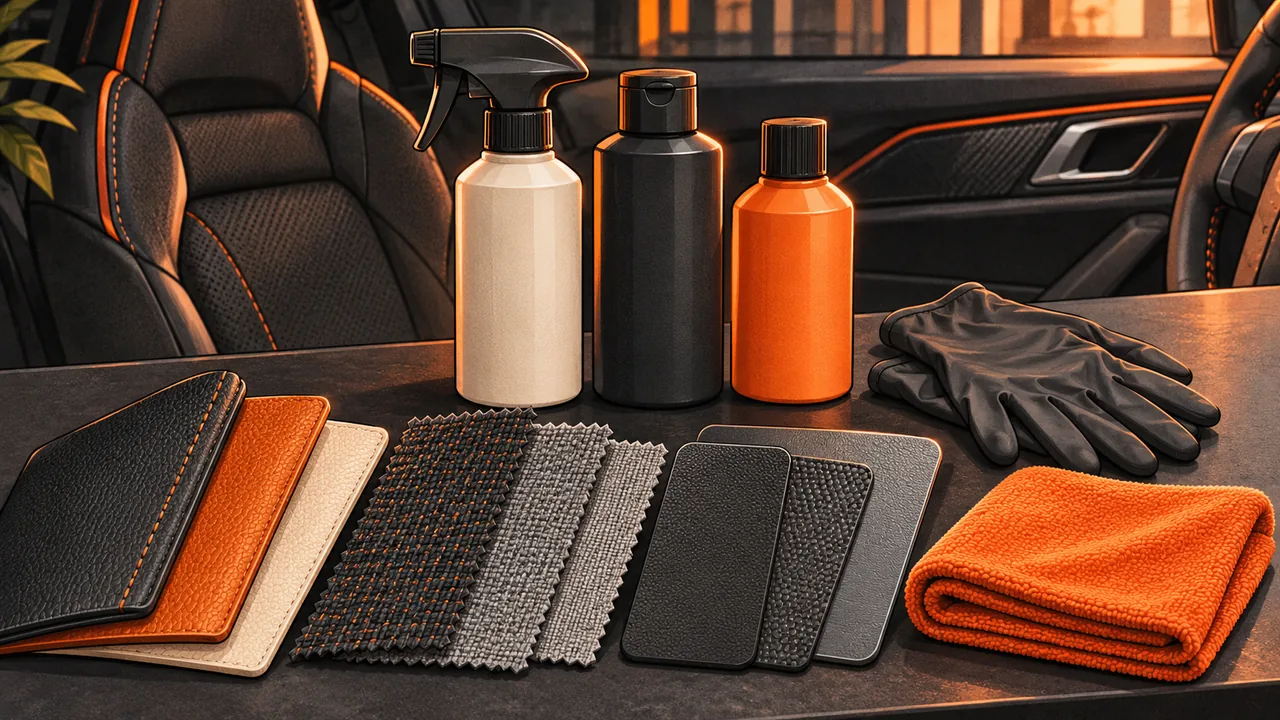
Select an interior cleaner by identifying the material, understanding the contamination and reading the product's actual instructions. A bottle labeled “all purpose” or “interior” does not establish compatibility with every screen, seat coating, headliner or repaired surface.
The decision is not simply which product is strongest. It is whether a particular process is suitable for the surface and problem, and whether the technician can control its application and remove residues as directed.
Identify what you are cleaning
Start with the vehicle's care information and any known aftermarket changes. A seat may combine several materials. A panel that looks like ordinary plastic may have a delicate coating. Repaired leather or recolored trim may respond differently from the original finish.
Record uncertain materials instead of guessing. Ask for the relevant manufacturer or repairer's guidance. Cleaning a concealed test area can reveal an immediate adverse effect, but it cannot prove long-term compatibility or cancel an explicit product exclusion.
A Ford owner-manual example treats fabrics, screens, seat belts and suede-like materials differently. Consult the correct manual for the actual vehicle rather than copying this example's instructions across models.
Identify the problem without overdiagnosing it
Loose dust, greasy residue, dye transfer, mineral residue, biological contamination and worn finish are different problems. Ask what happened and what has already been used. A mark that resists a mild cleaning attempt is not automatically evidence that a harsher cleaner is appropriate.
Look for the boundary between cleaning and repair. Missing color, cracking, peeling coatings and abraded fibers cannot be treated as ordinary soil. Document the concern before testing so an existing defect is not confused with a treatment result.
Read the label and SDS for different purposes
The product directions should tell you its intended uses, permitted surfaces, preparation, dilution if applicable, application and removal. The safety data sheet provides hazard and handling information. Neither replaces the vehicle's material restrictions.
OSHA's SDS guide identifies sections covering hazards, handling, protective controls and reactivity. Check that the sheet matches the exact product and current formulation, and keep it accessible where the product is used.
- Does the label permit this material and use?
- Is the product ready to use or a concentrate with specific directions?
- What protection, ventilation and handling controls are required?
- Must it be kept away from particular surfaces, heat or other chemicals?
- How should residues be removed, and what drying conditions are required?
Do not turn pH into a compatibility guarantee
A pH value describes one characteristic of a product. It does not tell you every ingredient, solvent effect or interaction with a finish. A product advertised as neutral can still be unsuitable for a particular component. Likewise, a product selected for one textile should not be transferred to a screen because both are inside a car.
Do not improvise mixtures or combine cleaning products. Use the manufacturer's directions for the exact product; there is no universal dilution or dwell-time recipe in this guide. If the instructions are unclear, ask the supplier before proceeding.
Run a controlled, appropriate test
When the product and material instructions permit testing, select an inconspicuous area and observe changes in color, texture, gloss and stability. Use the instructed method and evaluate after the relevant drying stage. Limit moisture around seams, electronics and sensitive layers according to the vehicle and product guidance.
An illustrative example: a mark on a seat bolster might appear to improve while the cloth picks up color. That is a reason to stop and assess the finish, not proof that more scrubbing is needed. The observation should be recorded for whoever decides the next step.
Build a usable chemical-selection record
Keep the product name, surface, applicable instructions, test observation and decision together. A shelf full of nearly identical bottles is less helpful than a smaller, understood set of products with clearly defined uses. Include equipment limitations when extraction, heat or steam is being considered.
See Lava GR's interior-detailing information for service context. To practice material identification and process selection with feedback, ask about hands-on detailing training. Bring the product labels and questions you actually encounter; a useful lesson should improve your reasoning as well as your technique.