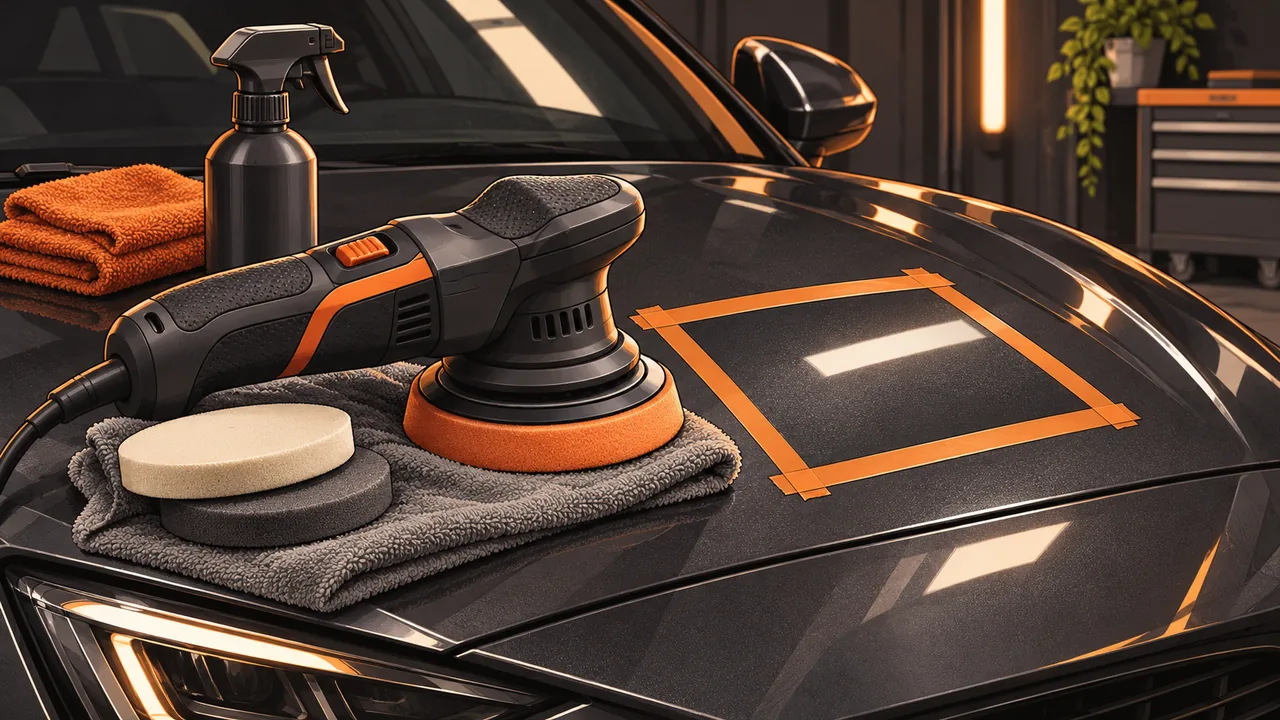
A useful paint-correction test spot is a controlled trial on a suitable, authorized surface. It helps you judge the improvement, the finish left behind and whether the process is appropriate to repeat. It is not permission to keep polishing until every mark disappears.
For a beginner, supervised practice on a suitable training panel offers a better learning environment than improvising on an unfamiliar customer's vehicle. The first goal is reliable observation and machine control, with a clear stopping point.
Describe the starting surface
Identify the type of finish and any known repaint, film, coating or repair history. Record the visible concern: broad wash marring, isolated scratches, haze or another defect. Conditions such as peeling clear coat or uncertain repairs require a different assessment before a correction plan.
Clean and inspect using procedures suitable for that surface. A reading from a paint-thickness instrument can inform assessment, but its meaning depends on the instrument, substrate and coating system. Do not treat a single number as a universal allowance for polishing.
Set a target you can evaluate
Write what a successful trial would look like. Examples include reducing fine wash marks while leaving the surface clear, or finding a finishing step that improves haze after a previous process. “Remove all damage” does not define a responsible limit.
Agree on the target with the instructor or customer before comparing combinations. A daily driver may benefit from a conservative improvement even when isolated deeper defects remain. The chosen goal should respect the condition of the finish and the owner's future maintenance needs.
Control the variables
Record the machine, pad, polish and relevant manufacturer procedure. Keep the trial area and inspection conditions consistent. Start with an appropriate conservative approach selected for the finish and task; “least aggressive” is not a substitute for knowing whether the product is compatible at all.
Change one variable when practical. If you simultaneously change the pad, liquid, pressure and working time, it becomes difficult to explain which change affected the result. Use clean, appropriate pads and towels and follow the machine's operating instructions.
3M's random-orbital procedure distinguishes compounding and polishing stages within a specified system. Its details should not be treated as interchangeable instructions for another machine, liquid or finish.
Inspect more than scratch reduction
- Clarity: Is there haze or a new pattern of fine marks?
- Remaining defects: Which concerns improved and which remain?
- Consistency: Does the area look similar from more than one viewing angle?
- Process behavior: Did the pad, product or surface behave unexpectedly?
- Repeatability: Can you explain the steps well enough to repeat them?
Use a compatible inspection process when evaluating residue. Removing polishing residue is not a reason to apply an arbitrary solvent. Product exclusions, repaired areas and adjacent materials still matter.
Recognize the decision to stop
Pause if the finish responds unexpectedly, the material is uncertain or further correction would require an approach outside your training. Do not use a scratch's visibility alone to decide how much work it can accept. Some damage needs touch-up, refinishing or acceptance of a remaining defect.
A test spot on one panel also does not prove that every panel has the same history or will respond identically. Reassess as the work progresses, especially where the finish changes or a repair becomes apparent.
Use a simple practice record
| Field | Example of useful information |
|---|---|
| Starting concern | Fine circular marks under the inspection lamp |
| Method | Exact machine, pad, liquid and applicable instructions |
| Observed result | Improved clarity; isolated scratch remains |
| Decision | Repeat, refine, investigate or stop |
The entries above are illustrative, not a claimed customer result. Comparable photographs and brief notes make the exercise more useful than relying on memory.
Read about Lava GR's paint-correction assessment for the owner-facing service context. If you want guided practice, send a hands-on training inquiry describing your current experience and the finish you struggle to evaluate. The learning goal is a better decision, not a guaranteed percentage of defect removal.