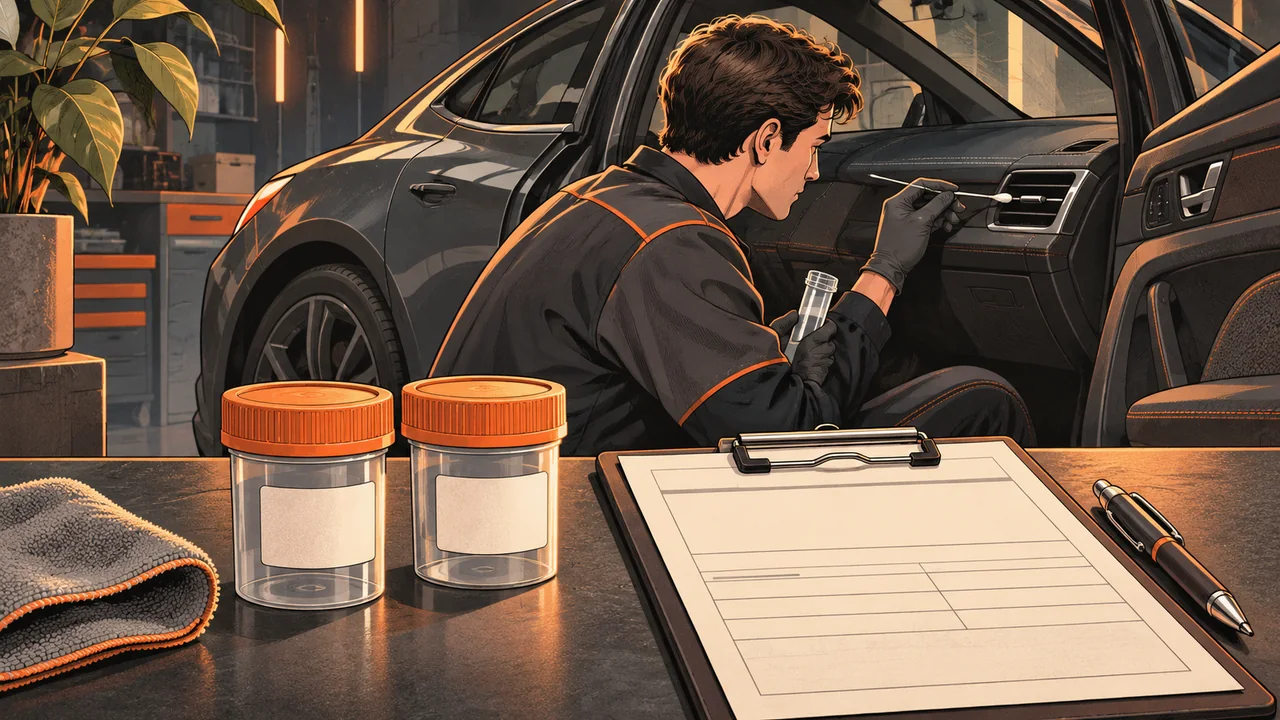
Start with the sample record, not the largest number on the report. Before a vehicle mold result can inform a useful conversation, the sample must be connected to a known location, collection method and date. A laboratory finding does not, by itself, identify the moisture source, describe every hidden surface or establish whether a vehicle is appropriate for a particular person to occupy.
This guide helps you read paperwork you already have. It does not recommend that every damp vehicle needs testing. EPA’s mold sampling guidance explains that visible growth often makes sampling unnecessary and that qualified interpretation matters. That guidance concerns buildings; it is not an EPA vehicle certification program.
Match the report to the collection record
Ask for the full laboratory report and the collection or chain-of-custody record that accompanied the samples. A screenshot of one result row may omit the information that explains it. EMSL’s published chain-of-custody form provides a useful example of the types of information laboratories ask collectors to record.
| Field to check | Question it should answer |
|---|---|
| Sample identifier | Does this exact identifier appear on the container record, collection notes and laboratory result? |
| Location and description | Was the sample collected in the cabin, outdoors, from a specific surface or somewhere else? |
| Method and material | Was it an air sample, a surface sample or material submitted to the laboratory? |
| Date and time | Was collection before or after cleaning, drying or another intervention? |
| Volume or area, where applicable | What collection information did the laboratory use to calculate the reported result? |
| Collector and custody | Who collected, transferred and received the sample? |
Do not fill in a missing location by guessing from the mold names. A description such as “Sample A” is not the same as a documented cabin sample. Ask the original collector to resolve discrepancies and preserve any corrected record with the original paperwork.
Understand what was happening during collection
A useful assessment also records the vehicle’s condition: recent rain or spills, whether doors or windows were open, whether the HVAC was operating, and whether cleaning products had recently been used. These observations help the assessor understand the setting. They are not instructions for conducting a test yourself.
For example, a result collected after the doors had been open and a result from a closed vehicle at another time are not automatically equivalent. The assessor should explain whether comparison is appropriate for the chosen method. An outdoor comparison, when part of the assessor’s design, still requires a verified location and collection record.
A lower number is not a universal clearance
NIOSH describes important limits of short-term mold air samples, including that results cannot be translated directly into health risk. Do not read a low or negative finding as proof that every carpet layer is clean, that a leak has stopped or that a person will have no symptoms.
Different methods can answer different questions. A surface finding concerns the sampled surface. An air result concerns the collected sample under its conditions. An assessor should explain the question each test was intended to answer and what it leaves unresolved. A detailer should not turn a laboratory page into a medical assurance.
Keep the assessment connected to the vehicle
Illustrative scenario: an owner has a report with two sample identifiers and a recurring wet rear footwell. The next useful step is to verify the sample locations and investigate the water entry. Ordering another unspecified test would not explain why that footwell becomes wet again.
A written assessment should separate observed facts, proposed work and remaining uncertainty. It may identify a need for leak diagnosis, closer inspection of affected materials, cleaning, replacement evaluation or a separate mechanical referral. The scope should follow the evidence gathered for that vehicle.
Five questions to take to the assessor
- What decision was this sampling designed to support?
- Can you show which result belongs to each documented collection location?
- Which conditions or method limits affect interpretation?
- What moisture source and affected materials were actually inspected?
- What evidence will you use to evaluate the proposed work, and what will remain outside its scope?
For water-related problems, review Lava GR’s vehicle water-intrusion service information. If you need a specialty assessment, contact Lava GR about contamination restoration and explain the concern. Send reports through the agreed private channel, with the relevant sample records; do not post customer identifiers or medical information publicly.