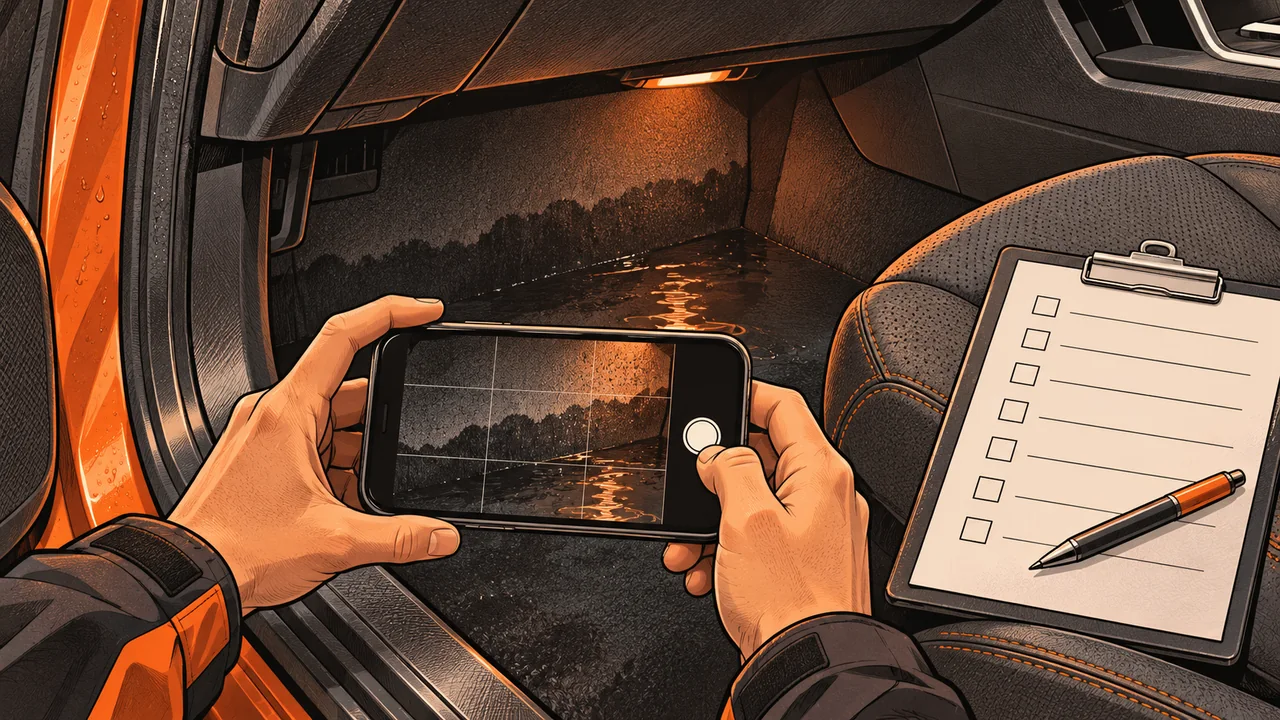
Document where the water appeared, when you noticed it and what happened immediately beforehand. Add a few clear photographs showing both the location and the visible condition. That combination is more useful for an assessment than a large, unlabeled camera roll or a confident guess about which seal failed.
You do not need to diagnose the leak to request help. Your task is to preserve what you observed without creating a new hazard or changing the evidence unnecessarily.
Start a short timeline
Write down the first date you noticed dampness, standing water or an unusual odor. Add the relevant circumstances: recent rain, a wash, a spill, glass or body work, or storage with the windows open. If the timing is uncertain, say so. “Noticed Monday; may have started earlier” is better than a precise date invented after the fact.
Record repeat events separately. If the same footwell becomes wet after each rain, list the observations rather than combining them into “always leaks.” Note what changed between events, including repairs or cleaning. This gives the assessor a sequence to investigate.
Take photographs at three distances
- Location view: show which door, seating row or cargo area you are photographing.
- Area view: show the affected carpet, trim or accessible compartment in context.
- Detail view: show a visible waterline, stain or other specific observation without relying on zoom that makes the image unreadable.
Use ordinary lighting and keep the camera steady. Save original files. Filters and dramatic color changes make comparison harder. If a mark is difficult to see, add a plain written description instead of drawing a conclusion the image cannot support.
Only photograph accessible areas from a position you can reach without dismantling the vehicle. Do not remove seats, covers or electrical components for the sake of a better record.
Label facts and assumptions differently
| Useful observation | Conclusion to leave for assessment |
|---|---|
| Rear passenger footwell felt damp after overnight rain. | The rear door seal definitely failed. |
| Water was visible in the accessible cargo compartment. | Every layer beneath the carpet is contaminated. |
| The odor returned after the vehicle was closed overnight. | A particular mold species is present. |
| Glass work was completed before the first noticed event. | The glass work caused the problem. |
This distinction keeps the record fair and useful. A professional may need separate testing or repair information to establish cause. The order in which events occurred can guide an investigation without proving responsibility.
Preserve relevant work records
Keep the inspection report, repair description, parts information and any source-repair confirmation together. Add what products or equipment were used in prior cleaning if known. If a technician supplies measurements, retain the measurement location, method and date, rather than copying only a number into a message.
Ask for permission before sharing another person’s private correspondence. For the service provider, share only records relevant to the assessment through the agreed private channel. Remove unrelated account details or personal documents from general photos.
Do not let documentation delay a necessary escalation
If the vehicle was flooded or there are electrical or battery concerns, photographs are secondary to qualified advice about handling and transport. NHTSA warns that flood damage can be hidden and recommends assessment before startup. A dry-looking interior is not a mechanical or electrical clearance.
This article does not establish insurance coverage or fault. Your records can explain the issue, but an insurer or other decision-maker applies its own process and requirements. Keep the original evidence and ask what additional documentation is needed.
A compact message to send with the photos
Illustrative wording: “I noticed moisture in the left rear footwell after rain. It has happened twice. The attached photos show the location and visible condition. A prior cleaning improved the appearance, but the area became damp again. I have not determined the entry point. What assessment should happen before further cleaning?”
For help deciding the next step, request a water-intrusion assessment from Lava GR. If your concern also involves suspected contamination, review the specialty restoration information and disclose it in your first message so the scope can be considered before drop-off.